Aflatoxin And Storage Recommendations For Infected Grain
Shelly Kerns, Boyd Padgett, and Trey Price, LSU AgCenter Scientists
SHELLY KERNS, BOYD PADGETT AND TREY PRICE
BATON ROUGE, LOUISIANA
There has been an abundance of ear rots reported in Louisiana throughout this growing season. As the harvest window is winding down, and with many growers already finished with harvest, I have heard of one reoccurring issue in particular: aflatoxin. There have been reports of heavy docking and even loads being rejected at the elevators. In addition to this, there are now many growers who are planning to store their grain who have been inquiring about storage guidelines for infected grain. Overall, there have been many questions about why aflatoxin levels have been so high this year. Below is a summary of aflatoxin development/production and recommendations for storing infected grain.
Mycotoxin Development
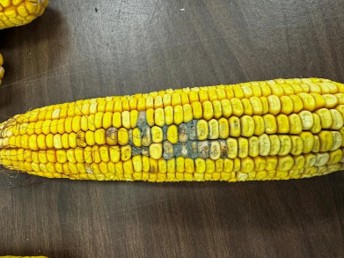
Aflatoxin is a mycotoxin, meaning that it is a toxic chemical produced by fungi. Aflatoxin can only be produced by two species of Aspergillus that are plant pathogenic (A. flavus and A. parasiticus). Aspergillus primarily presents in infected corn plants as an ear rot pathogen. Ears with Aspergillus ear rot will exhibit as a fuzzy or felt-like olive-green mold (image 1). It is important to note that just because an ear is infected does not mean the fungus will produce aflatoxin. It is only when corn plants enter severe stress that the fungal pathogen can be triggered to start producing the mycotoxin.
Aflatoxin production is historically associated with high heat, severe drought, and high humidity. Our growing season had a substantial wet period, and because of this, there has been confusion on why aflatoxin presence has been so bad this year. Aspergillus overwinters in the soil. Rainfall created the perfect environment for spread of fungal spores. Raindrops can splash spores from soil to plants within a field, and wind can also pick up spores and disperse them further. Once the rainfall subsided, spores were most likely able to start germinating and infecting plants. Aspergillus spores can infect through the silks during the late silking stage, or through wounds caused by physical environmental injury or insect feeding. As the season progressed and the weather became extremely dry, this probably triggered Aspergillus to start producing aflatoxin.
Management Practices to Mitigate Aflatoxin Production
-
Plant hybrids with good earworm resistance. Aflatoxin is more likely to develop in ears and kernels damaged by insect feeding.
-
Consider biological applications. There are biological products such as Afla-Guard, F-36 Prevail™ / AF-36 Prime, and FourSure that can be applied from mid vegetative stages up until silking. Application of these products should be prioritized on non-irrigated fields. More information about how these products work can be found here: https://cropprotectionnetwork.org/publications/usi…
-
Plant drought resistant hybrids when possible. Especially if planting corn behind corn in a field that has a history of ear rots. Irrigate when feasible.
-
Rotate crops. Crop rotation to a non-host crop such as soybean can help reduce the amount of Aspergillus inoculum in soil between growing seasons.
-
Till the soil. Tillage physically breaks up and buries infected crops residue. This slows down fungal spore production.
Harvest and Storage Recommendations
-
Consider harvesting irrigated fields separately from non-irrigated fields when possible, prioritizing irrigated fields first. Cross contamination can occur from leftover grain in trucks, holding bins, and drying facilities.
-
Adjust your combine settings. If you know you will be harvesting a field with substantial kernel damage, adjust the cylindrical speed and fan airflow to filter out damaged kernels.
-
Rapidly dry grain that you are planning to store. It is recommended to dry down infected grain within 24-48 hours after harvest. To prevent the spread of Aspergillus growth and further aflatoxin development, the grain should be dried between 14-13% moisture for long term storage.
-
Keep stored grain cool. Storage temperatures below 55 degrees Fahrenheit are ideal. Also aerate the grain if storing in bins. This helps prevent moisture condensation which is conducive for fungal growth.
-
Evaluating the Effects of Extreme Weather Conditions on Louisiana Soybean Development and Yield in 2026
-
David Moseley, LSU AgCenter Soybean Specialist
-
The 2026 Louisiana soybean growing season included several weather extremes that may affect yield. The amount of any yield loss will be difficult to determine until harvest because crop response varies with growth stage, soil type, drainage, irrigation, and other management practices. In addition, statewide and regional weather summaries do not capture the conditions experienced in every field.
-
Four major weather-related events or patterns affected Louisiana soybean production during 2026: a freeze on March 17, above-average temperatures during March and April, excessive rainfall and flooding during May and June, and hot and dry conditions in July and August.
-
Figure 1 shows that 75% of the Louisiana soybean crop was planted by April 25, approximately 13 days earlier than the five-year average date of May 8. This early planting probably contributed to the earlier occurrence of subsequent developmental milestones. Statewide, the 75% dates for beginning bloom, pod set, and beginning color occurred approximately 11 to 14 days earlier than their respective five-year averages. Above-average maximum and minimum temperatures during March and April may have further accelerated soybean growth and development (Figure 2).
The March 17 freeze damaged some of the earliest-planted soybean fields in Louisiana. Observed injury included damage to unifoliate leaves and the apical meristem. However, many affected plants recovered by producing axillary branches from lower nodes. The statewide impact of the event was limited because only approximately 1% of Louisiana soybean acreage had been planted when the freeze occurred.
Excessive rainfall during May and June created saturated soil conditions in many fields and caused severe flooding in portions of central Louisiana (Figure 2). Rainfall associated with Tropical Storm Arthur was especially intense in the central Louisiana region, where approximately 30 inches of rainfall in less than 12 hours was reported. Preliminary assessments indicated that approximately 114,000 soybean acres were affected by the flooding. Nearly 38,000 acres were considered complete crop losses, while persistent wet conditions prevented the planting of an additional 15,000 acres. Many surviving fields experienced partial stand loss or other injuries that could reduce yield and profitability. Total economic losses to Louisiana soybean production were estimated at approximately $33 million, based on an LSU AgCenter damage assessment.
Nighttime temperatures during June and July were generally above their recent averages. Warm nighttime conditions can increase plant respiration and the use of carbohydrates produced through daytime photosynthesis. This inefficient use of energy by the plant can reduce yield; however, the effect of the higher-than-average temperatures could have been mitigated by the adequate soil moisture by supporting transpiration and evaporative cooling. Therefore, frequent rainfall during May and June may have moderated heat stress in fields with adequate drainage. In poorly drained or flooded fields, however, the benefits of available water were likely outweighed by oxygen deficiency and impaired root function. Heat and saturated soil conditions can interact because warm temperatures increase plant and microbial oxygen demand in already oxygen-limited soils.
In July and August, rainfall was below and the maximum temperature was above the 2020–2025 average in Chase and Alexandria, LA. The potential consequences of higher heat and drying pattern differed among fields because soybean development was early in 2026. Soybeans planted during the early and middle portions of the recommended planting window were generally farther along in seed fill or beginning to mature, whereas later-planted fields could still have been at growth stages that were more susceptible to heat and drought stress. ∆
SHELLY KERNS, BOYD PADGETT AND TREY PRICE
LSU AGCENTER
Figure 1. A corn ear from the Avoyelles parish corn core block displaying “fluffy” olive-green Aspergillus ear rot.
Figure 1. Estimated dates when 75% of Louisiana soybean acreage reached selected developmental milestones during 2026 compared with the five-year average. Source: USDA-NASS.
Figure 2. Monthly average maximum and minimum air temperatures and total rainfall at Chase, LA during 2026 compared with the 2020–2025 averages. Source: Louisiana Agriclimatic Information System.
Link to Original Article: file:///C:/Users/User/Desktop/Volume%2016,%20Issue%206%20-%20September%202026.html