

KIERSTEN WISE
LEXINGTON, KENTUCKY
Although it is only the first week of June, corn across western Kentucky will be tasseling before we know it. Many fields are at V10 or beyond, prompting questions about fungicide applications and favorable disease conditions.
Frequent rainfall across the state has led to some detections of Holcus leaf spot (caused by the bacteria Pseudomonas syringae pv. syringae). To date, no concerning levels of disease have been observed, but it is important to scout frequently, monitor University resources, and be prepared to act if conditions warrant foliar disease management. In most cases, a single foliar fungicide application at tasseling/silking (VT/R1) will be most effective at preventing yield loss due to foliar diseases and provides the greatest chance of seeing a positive return on investment.
One of the most important corn diseases to monitor in Kentucky is southern rust (caused by Puccinia polysora). The fungus that causes southern rust does not overwinter in Kentucky, but spores of the fungus move north on wind currents and weather each summer. We can track the movement of southern rust by watching the map on the Crop Protection Network mapping website. Southern rust typically arrives in Kentucky in mid-July, and whether a fungicide will be needed to manage southern rust at that time will depend on the crop growth stage at the time it is detected in an area. Fungicide applications may be needed to manage southern rust through the milk (R3) growth stage. With Kentucky corn tasseling earlier than normal, it is possible that there will be minimal impact of southern rust this year, but we will continue to monitor the disease.
Most questions right now are regarding favorable conditions for tar spot (caused by Phyllachora maydis) in Kentucky. Tar spot has not been problematic in Kentucky because our hot, humid summers limit infection and disease development. However, our current crop stages in western KY and our cooler weather have created some risk for tar spot development based on the Crop Risk Tool, that can forecast disease risk for tar spot and gray leaf spot for corn that is between growth stages V10 and R3 (Figure 1). Despite this current elevated risk, it appears that risk will decrease in the next week or so, as temperatures and humidity increase. In most cases, applying a foliar fungicide once at tasseling/silking (VT/R1) is the most effective way to prevent yield loss from foliar diseases like tar spot and gray leaf spot and offers the greatest potential for a positive return on investment (ROI).
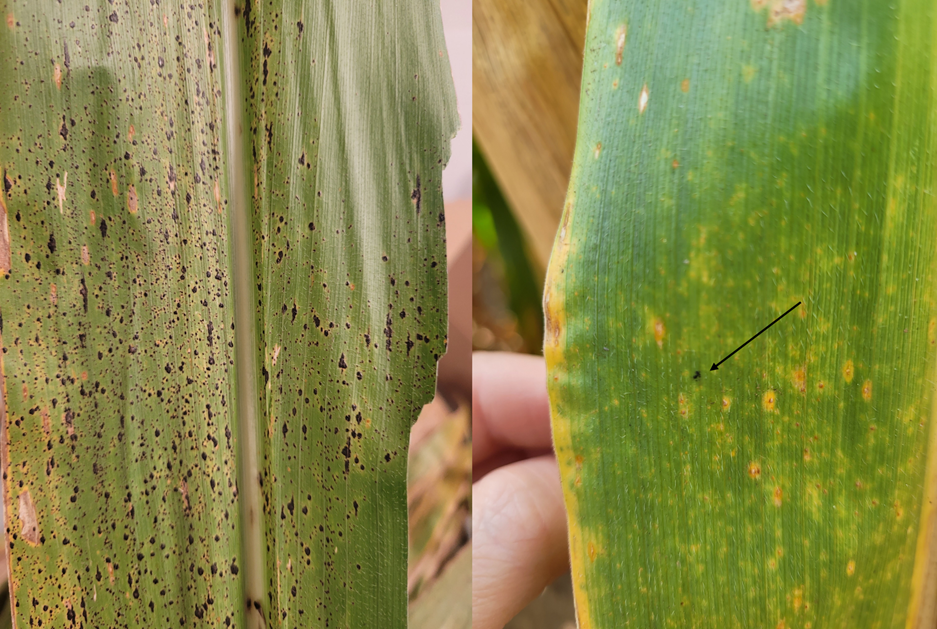
Tar spot can be easily confused with insect frass, which is plentiful in corn at this time of year. Tar spot lesions are raised and feel bumpy on the leaf surface and often are surrounded by a small brown or tan halo (Fig. 2). Insect frass will not have a halo or margin surrounding the lesion, and should wash off with water. Always submit suspected tar spot samples to your County Agent for submission to the Plant Disease Diagnostic Laboratory for confirmation.
Scouting over the next few weeks and just prior to tasseling can help determine if fungicide applications are needed. Although disease levels will continue to build over the course of the season, University research indicates that foliar fungicides applied at tasseling or early silking (VT-R1) provide optimal foliar disease control for diseases like gray leaf spot and tar spot compared to applications that occur earlier or later in the season. For southern rust, a fungicide application may be needed through milk (R3). ∆
Figure 1. Example of Crop Risk Tool model prediction for tar spot risk for locations in western Kentucky from June 2, 2026.
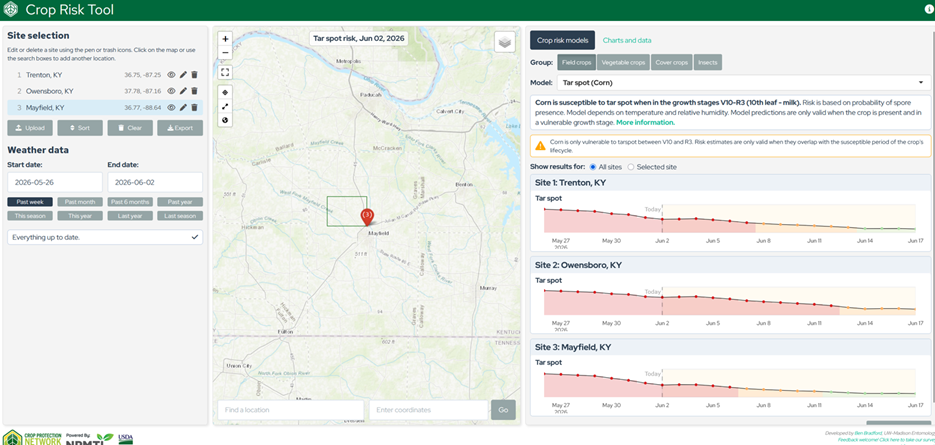
Figure 2. Tar spot lesions (left) and insect frass (right) on corn leaves (Photos: Kiersten Wise)
Link to Original Article: https://kentuckypestnews.wordpress.com/2026/06/02/time-to-scout-for-corn-diseases/?utm_source=KY+Pest+News+List&utm_campaign=f692afb3d6-KPN_NEWSLETTER_EMAIL_CAMPAIGN&utm_medium=email&utm_term=0_bee884adb8-f692afb3d6-163945889&ct=t(RSS_EMAIL_CAMPAIGN)